
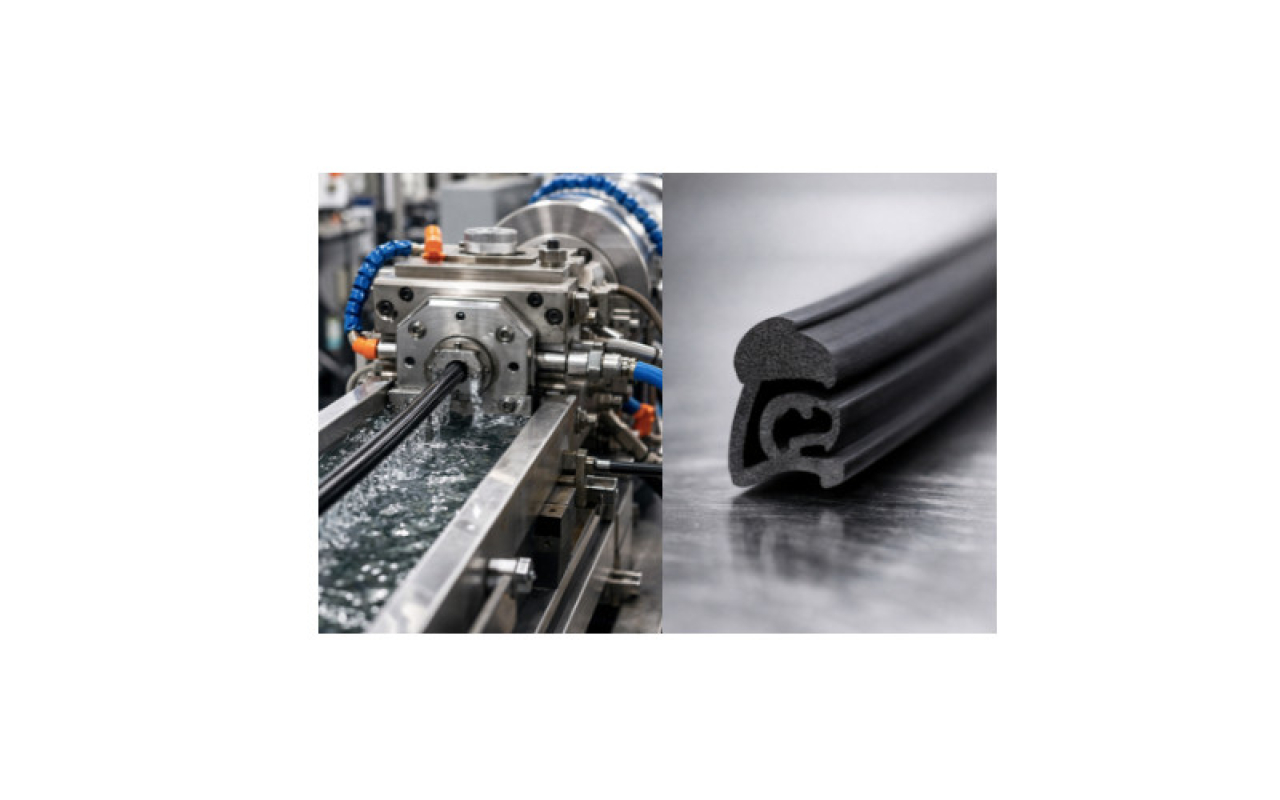
In this article, we explore the unique advantages of extrusion for small custom profiles, key design considerations, material options, and how precision extrusion supports modern product development.
What Is Profile Extrusion?
Profile extrusion is a continuous manufacturing process in which molten thermoplastic or elastomer material is forced through a shaped die to create a constant cross-section. After exiting the die, the profile is cooled, calibrated, and cut to length or wound.
For small specialized profiles, typical dimensions may range from fractions of a millimeter up to about 50 mm cross-section width. These profiles can include:
- Sealing and gasket profiles
- Technical trims and edging strips
- Functional inserts and rails
- Cable guides and channels
- Marine deck caulking or decorative lines
- Custom multi-material micro-profiles
Because extrusion produces long continuous lengths, it is ideal for applications requiring consistent geometry over meters or kilometers, with minimal waste and excellent repeatability.
Advantages of Extrusion for Small Custom Profiles
1. Design Freedom and Custom Geometry
Extrusion allows almost unlimited cross-section design possibilities. Even very small features—grooves, lips, hollow chambers, snap-fits, or co-extruded layers—can be integrated into a single profile. This reduces part count and assembly time in downstream products.
2. Tight Tolerances and Consistency
Precision tooling and modern calibration systems enable tight dimensional tolerances even for miniature profiles. This is essential for sealing, sliding, or interfacing components where fit and function depend on exact geometry.
3. Material Efficiency
Extrusion uses material efficiently, with minimal scrap compared to machining or molding. For high-performance polymers or specialty compounds, this can significantly reduce production costs.
4. Scalable Production
Once tooling is developed, extrusion offers excellent scalability—from small production batches to continuous high-volume runs. This makes it suitable for both niche technical products and mass-produced components.
5. Multi-Material Integration
Co-extrusion allows combining different materials in one profile—such as rigid + flexible zones, color stripes, wear layers, or sealing lips—without secondary assembly. This is particularly valuable in small technical profiles where space is limited.
Key Design Considerations for Small Extruded Profiles
Designing small extrusion profiles requires specialized knowledge beyond standard extrusion. Important factors include:
Wall Thickness Balance
Uniform wall thickness promotes even material flow and dimensional stability. Sudden thickness changes can cause distortion or internal stress.
Minimum Feature Size
Very fine features are possible, but must respect material viscosity and die manufacturing limits. Experienced extrusion engineers can optimize geometry for manufacturability.
Material Shrinkage
Different polymers shrink differently during cooling. Precise die design compensates for shrinkage to achieve final dimensions.
Tolerance Strategy
Small profiles often require selective tight tolerances only in functional zones. This approach improves yield and cost efficiency.
Post-Processing Needs
Cutting, punching, welding, or bonding considerations should be integrated early in profile design.
Collaborating with an extrusion partner during early design stages significantly improves performance and manufacturability.
Materials for Small Specialized Profiles
A wide range of thermoplastics and elastomers can be extruded into miniature profiles. Common choices include:
- PVC (rigid and flexible) – cost-effective, durable, weather-resistant
- TPE / TPV – flexible, elastic sealing and soft-touch applications
- PE / LDPE / HDPE – chemical resistance, low friction
- PP – lightweight and fatigue-resistant
- ABS – impact-resistant technical parts
- PA (Nylon) – high strength and wear resistance
- Specialty compounds – UV-stable, flame-retardant, marine-grade, or conductive
Material selection depends on mechanical load, environmental exposure, temperature range, and regulatory requirements.
Applications of Small Extruded Profiles
Precision extrusion profiles are used across many industries:
Marine and Boatbuilding
Deck caulking lines, decorative inlays, sealing profiles, edge trims, and structural inserts.
Automotive and Mobility
Interior trim strips, sealing lips, cable channels, sensor housings, and flexible guides.
Electronics and Appliances
Wire management profiles, insulation channels, micro-gaskets, and protective edging.
Construction and Architecture
Window accessories, façade details, sealing systems, and technical trims.
Industrial Equipment
Guide rails, wear strips, protective edges, and machine interface components.
The ability to tailor geometry, material, and color makes extrusion ideal for OEM-specific solutions.
Why Choose a Specialized Extrusion Partner?
Producing small precision profiles requires more than standard extrusion capability. Key competencies include:
- Micro-scale die design and precision tooling
- Stable process control for narrow tolerances
- Advanced material compounding knowledge
- Co-extrusion and multi-material integration
- Custom finishing, welding, or assembly
- Flexible batch sizes for niche applications
An experienced extrusion manufacturer can translate CAD cross-sections (DXF, STEP, or STP) directly into optimized tooling and production processes, ensuring reliable series manufacturing.
Extrusion is the optimal manufacturing method for small, specialized plastic profiles that require consistent geometry, material efficiency, and scalable production. From marine decking lines to technical sealing systems and micro-functional components, precision extrusion enables innovative designs that simplify assemblies and enhance product performance.
If your project requires custom small-dimension extrusion profiles—whether flexible, rigid, or multi-material—working with a specialist partner ensures the best results from design through production.
? Learn more about our custom small-profile extrusion manufacturing:
 Extrusion is one of the most versatile and cost-efficient manufacturing processes for producing continuous plastic and elastomer profiles. While it
 The Government of Nova Scotia has unveiled a new registration levy targeting electric and hybrid vehicle owners. The measure, announced
 Embarking on a journey through the intricate world of custom foam creations, you'll quickly realize the paramount importance of precision

